
Economic forecasts change. Business priorities evolve. Leadership teams adjust their expectations for growth, capital investment, staffing, and operational performance.
But the contractual obligations within an organization’s real estate portfolio do not necessarily change with them.
A lease negotiated under one set of business assumptions may remain enforceable long after those assumptions have changed.
For occupiers, this creates an important leadership challenge: How can organizations make responsible real estate decisions today without unnecessarily limiting their choices tomorrow?
The answer requires looking beyond individual transactions and examining the cumulative consequences of decisions across the portfolio.
The Portfolio Leadership Inherits
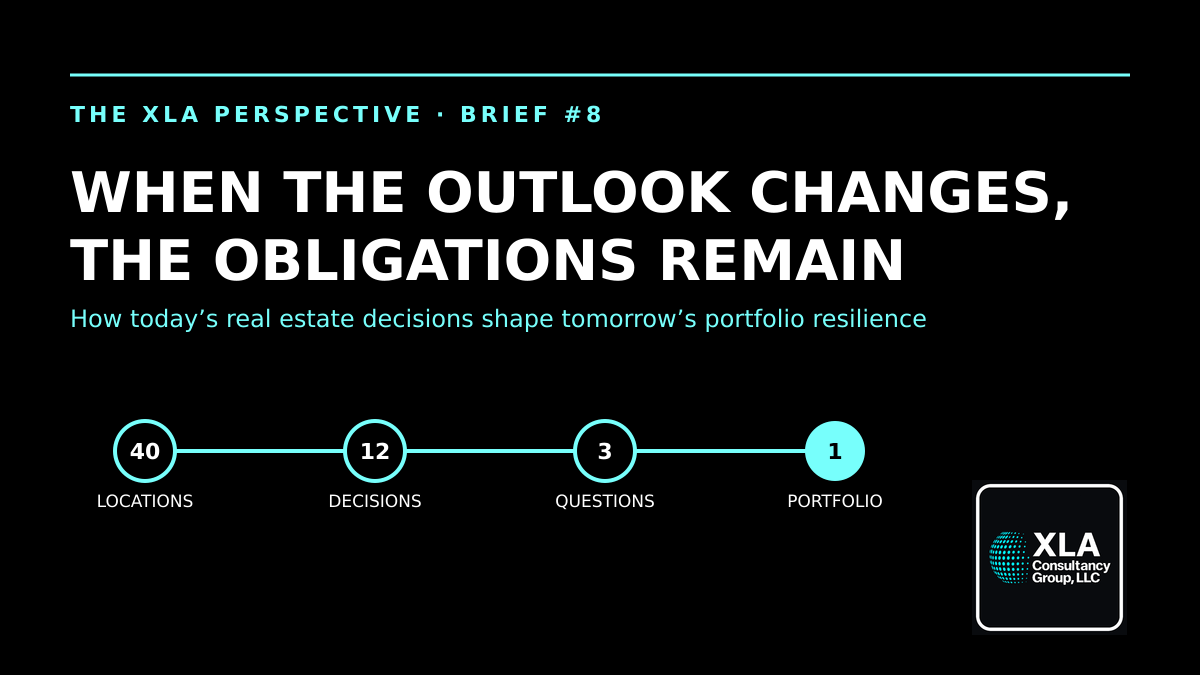
Consider a fictional organization operating 40 leased locations.
The business has historically evaluated renewals, relocations, and consolidations primarily at the individual-property level. Each transaction receives financial review, operational input, and the necessary approvals.
The process appears disciplined.
However, a broader portfolio assessment identifies a developing concern.
Twelve locations have significant lease decisions approaching within the next 24 months.
Of those twelve:
- Six continue to support established business requirements.
- Four face changing space or operational requirements.
- Two may no longer align with the organization’s longer-term strategy.
The remaining 28 locations have no comparable decisions scheduled during that period.
These figures are illustrative, not industry benchmarks or actual client data.
Leadership must now determine whether the organization should renew, restructure, consolidate, relocate, or preserve existing arrangements where possible.
The challenge is not simply choosing the least expensive option at each property.
It is understanding what those decisions will mean collectively.
When Reasonable Decisions Create Unnecessary Exposure
Suppose the organization renews all twelve locations for five years.
At the individual-property level, those renewals may appear attractive. They avoid immediate relocation costs, preserve operational continuity, and potentially secure favorable commercial terms.
But the organization may also have extended commitments at locations where future requirements remain uncertain.
The six stable locations may justify longer commitments.
The four locations with changing requirements may benefit from shorter extensions, expansion or contraction rights, or other negotiated flexibility.
The two strategically questionable locations may warrant a more comprehensive evaluation before additional commitments are made.
A uniform renewal strategy could overlook these distinctions.
It could also create a concentration of future expirations, placing multiple decisions, negotiations, and capital requirements into the same planning period.
The organization might save money today while increasing its exposure to tomorrow’s uncertainty.
The central question is whether the organization is managing twelve individual transactions or making twelve decisions about the future composition of one portfolio.
Three Questions Leadership Should Ask
1. What have we committed to?
Leadership needs a reliable understanding of existing obligations, including remaining lease terms, contractual rent, escalation provisions, termination rights, renewal options, notice requirements, and other material conditions.
These commitments establish the organization’s contractual starting position.
They must be distinguished from projected costs, anticipated negotiations, and opportunities that have not yet been secured.
2. What future choices are we preserving or surrendering?
Not every lease decision should maximize flexibility.
Longer commitments may provide valuable cost certainty, operational stability, or access to strategically important locations.
However, leadership should understand the tradeoff.
A lower rental rate accompanied by a longer commitment may be appropriate for a stable location but less attractive where business requirements are changing.
The objective is not flexibility at any cost. It is ensuring that the flexibility retained is appropriate to the business risk.
3. How will we know whether the portfolio is becoming stronger?
Portfolio resilience requires more than monitoring total occupancy costs.
Leadership should also evaluate the distribution of lease expirations, exposure to uncertain locations, opportunities to adapt space requirements, and the alignment between contractual commitments and operating strategy.
A portfolio can become less expensive without becoming more resilient.
Likewise, a portfolio may require additional near-term investment to improve its longer-term adaptability.
Turning Portfolio Resilience Into a Management Discipline
For the fictional 40-location organization, the next step would be to develop a coordinated decision calendar for the twelve approaching lease events.
Each location would be evaluated against consistent criteria, including contractual obligations, business importance, operational requirements, financial exposure, and available alternatives.
Leadership could then compare the cumulative effects of different strategies.
For example, renewing six stable locations, negotiating flexibility at four, and evaluating alternatives for two could produce a more adaptable portfolio than renewing all twelve under similar terms.
That outcome is not guaranteed. It would need to be demonstrated through property-specific financial and operational analysis.
The important distinction is that leadership would evaluate both the individual decisions and their collective consequences.
Lease administration plays a foundational role by ensuring that contractual information is accurate, current, and accessible.
Portfolio management connects that information to the organization’s broader business requirements.
Together, these disciplines help leadership understand not only what the organization occupies today, but what it is committing itself to occupy tomorrow.
The XLA Principle
Every decision contributes to the portfolio an organization will inherit tomorrow.
Economic conditions will continue to change. Business strategies will evolve. New opportunities and challenges will emerge.
Organizations cannot eliminate uncertainty.
They can, however, make more deliberate choices about the obligations they assume, the flexibility they preserve, and the portfolio they are building.
The objective is not to predict tomorrow perfectly.
It is to avoid making tomorrow unnecessarily difficult.